

Most Japanese learning apps have one move when you get something wrong.
A red X.
Maybe a quick flash of the correct answer. Then on to the next question.
That is not teaching. That is testing. And the problem with testing without teaching is that you make the same mistake again tomorrow. And the day after that. You keep circling the same gap without ever filling it.
We built Nihongo Master to do better than that. And today, we are.
Nihongo Master now has an AI Japanese teacher. His name is Professor Toshiro. And he is here to make sure you actually learn from your mistakes — not just move past them.
Who Is Professor Toshiro?
Professor Toshiro is an AI teacher built directly into the Nihongo Master experience. He is not a chatbot you have to go find. He is not a help section buried in a menu. He is part of your daily learning session, showing up exactly when you need him.
He does two things that no other feature in the app has done before.
First, he greets you every time you log in. Not with a generic "welcome back" banner. With a personal note — a look at where you are in your studies and a nudge toward your next step. So instead of opening the app and wondering where to start, you already know. Toshiro tells you.
Second, he catches you when you slip up. If you answer a drill or quiz question incorrectly, Toshiro steps in with an explanation. Plain English. No jargon. He tells you the rule you missed, gives you context for why the answer is what it is, and links you directly to the lessons you should review.
One quick tip. One click to the right lesson. Back to studying in seconds.
What It Looks Like in Practice
Here is a real example of how this works.
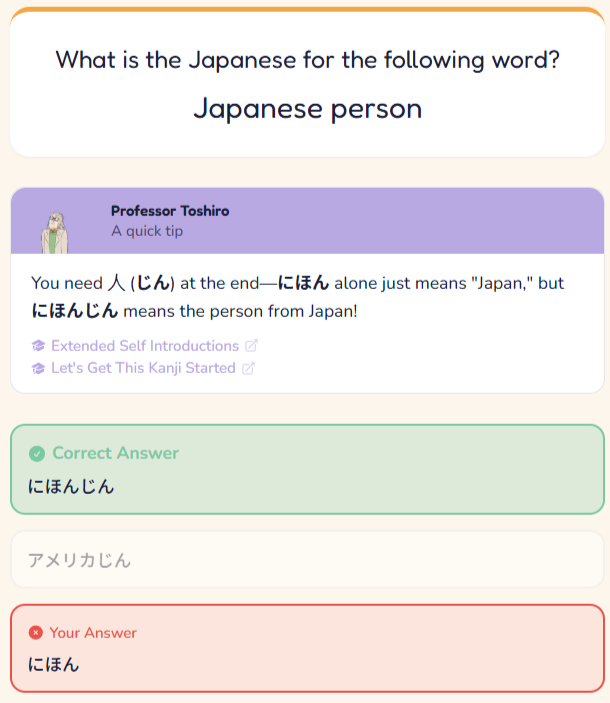
You are in a drill. The question is about Japanese nationalities. You type にほん when the correct answer is にほんじん. Easy mistake — both words share the same root. You know what にほん means. You just forgot the suffix that turns a country name into a nationality.
Before Professor Toshiro, you would have seen the correct answer and moved on. You might make the same mistake next time.
With Professor Toshiro, you get a quick tip explaining the difference. He breaks down why にほんじん is correct. Then he links you to two lessons — Extended Self Introductions and Let's Get This Kanji Started — so you can go back and lock it in.
That is the difference between knowing you got something wrong and understanding why. One of those leads to real progress. The other just leads to frustration.
Why This Matters for Learning Japanese
Language learning research is pretty clear on one thing: understanding your errors is more valuable than just correcting them.
When you get instant feedback that tells you the rule, your brain has something to attach the memory to. It is not just "I missed this one." It is "I missed this because of how Japanese handles nationalities, and now I know the pattern." That kind of contextual understanding sticks. A red X does not.
This is especially important in Japanese because the language is full of patterns that look similar but mean different things. Verb conjugations. Particle usage. Counters. Kanji with multiple readings. The number of places where a small mistake can mean something very different is high. Having a teacher who explains the specific rule you tripped on is not a nice extra. It is a core part of learning the language well.
Professor Toshiro also solves a problem that every self-study learner knows: motivation. Showing up to practice every day is hard when you feel like you are spinning your wheels. Knowing that someone — even an AI someone — is watching your progress, noticing your patterns, and pointing you in the right direction makes the whole experience feel less like guessing in the dark.
The Second Big Launch: Community Groups
Professor Toshiro is not the only thing we shipped today.
We also launched Community Groups — a brand new way to connect with other learners inside Nihongo Master.
Learning a language is inherently social. You are trying to communicate with people. But most language learning apps are solo experiences. You drill alone. You test alone. You wonder alone whether you are doing it right.
Community Groups fix that.
We have launched 12 discussion groups organized by topic and JLPT level. Every group has its own space for threads, replies, and conversations. You can ask questions, share resources, celebrate wins, or just talk to people who understand what it is like to stare at a kanji you have seen thirty times and still forget.
Here are the groups live right now:
- Introductions — Say hi. Tell everyone why you are learning Japanese.
- Beginner Help — Ask anything. No question is too basic here.
- Grammar Deep Dives — For when you want to really understand the why behind the rules.
- Kanji & Vocab — Tips, tricks, mnemonics, and study strategies for vocabulary.
- Anime, Manga & Games — Talk about the shows, books, and games fueling your motivation.
- Japanese Music — J-pop, city pop, enka, whatever you are listening to.
- Living in Japan & Travel — Practical Japanese for real-world use. Moving, visiting, surviving.
- JLPT N5 — Study together. Share practice resources. Prep for the entry-level exam.
- JLPT N4 — The next step up. Find study partners and swap strategies.
- JLPT N3 — Mid-level territory. This is where it gets real.
- JLPT N2 — For serious learners pushing toward advanced proficiency.
- JLPT N1 — The summit. The most difficult JLPT level. Find your people.
Community Groups are available to all Nihongo Master subscribers. Jump in, introduce yourself, and find the conversations that match where you are in your learning.
Everything in One Place, Getting Better
Nihongo Master has always been built around the idea that you should not need five different apps to learn Japanese. Lessons, drills, a dictionary, quizzes, practice sheets, and a community — all in one place.
Professor Toshiro and Community Groups are the next layer of that idea.
Toshiro adds intelligence to your practice. He makes your drill sessions more than just repetition — he turns your mistakes into lessons. Community Groups add people to your journey. They make the solo slog feel less solo.
Together, they make Nihongo Master feel less like a study tool and more like a learning environment. One where you have guidance when you need it and company when you want it.
How to Find Both Features
If you are already a subscriber, you do not have to go looking for these. Just log in.
Professor Toshiro will greet you on your dashboard with a note about where to focus today. From there, any time you answer a drill or quiz question incorrectly, look for his feedback card. It will show up automatically — a tip, the correct context, and links to the right lessons.
Community Groups are in your subscriber area at /community. Browse all 12 groups, find the ones that match your level and interests, and start a thread or jump into an existing conversation.
If you are not a subscriber yet, you can try Nihongo Master free for 7 days. No credit card required. You will have access to the full platform — lessons, drills, dictionary, quizzes, practice sheets, and now Professor Toshiro and Community Groups.
What Is Next
We are not done building.
Professor Toshiro will get smarter over time. More personalized feedback. Better pattern recognition across your full drill history. More specific lesson recommendations as we learn more about how students actually make mistakes.
Community Groups will grow too. More groups, richer discussions, and features that connect your community activity to your learning progress.
If you have thoughts on either feature — what you love, what you want to see next — head to the Introductions group and tell us. We are listening.
Free Japanese learning resources
Everything you need to start — no account required.
- Free Hiragana Chart All 46 characters with readings, stroke order & a printable PDF.
- Free Katakana Chart The full katakana syllabary plus a free downloadable chart.
- Free JLPT N5 Practice Test Test your level with instant scoring and answer explanations.
- Free JLPT Levels Guide All five levels explained, with tests and complete study lists.
- Tool Japanese Dictionary Look up any word with readings, meanings, and example sentences.
- Free JLPT Study Lists Complete kanji and vocabulary lists for every level, N5 to N1.
- Free Mobile Apps Free iPhone apps: master the kana and use the dictionary offline.