
Hiragana Chart: All 46 Characters with Readings & Stroke Order
Hiragana is the first Japanese alphabet most learners study. This complete chart shows all 46 basic characters with their romaji readings — tap any character to hear it, watch its stroke order, or practice writing it. You can also download a free printable PDF.
The complete hiragana chart

Download the free printable hiragana chart (PDF)
Print it for your desk or save it to your phone for studying on the go. No email required — it's a direct download.
Download the free PDFFree printable hiragana stroke order writing sheets (PDF)
One sheet per row of the chart. Each character is shown with its numbered stroke order, then trace-over boxes and blank boxes to practice writing it yourself. Free, no email required — print as many as you like.
- あ Practice Hiragana: あ to お あ い う え お · PDF
- か Practice Hiragana: か to こ か き く け こ · PDF
- が Practice Hiragana: が to ご が ぎ ぐ げ ご · PDF
- さ Practice Hiragana: さ to そ さ し す せ そ · PDF
- ざ Practice Hiragana: ざ to ぞ ざ じ ず ぜ ぞ · PDF
- た Practice Hiragana: た to と た ち つ て と · PDF
- だ Practice Hiragana: だ to ど だ ぢ づ で ど · PDF
- な Practice Hiragana: な to の な に ぬ ね の · PDF
- は Practice Hiragana: は to ほ は ひ ふ へ ほ · PDF
- ば Practice Hiragana: ば to ぽ ば び ぶ べ ぼ ぱ ぴ ぷ ぺ ぽ · PDF
- ま Practice Hiragana: ま to も ま み む め も · PDF
- や Practice Hiragana: や to よ や ゆ よ · PDF
- ら Practice Hiragana: ら to ろ ら り る れ ろ · PDF
- わ Practice: わ, を and ん わ を ん · PDF
What is hiragana?
Hiragana (ひらがな) is one of the two phonetic alphabets used in written Japanese, alongside katakana. Each character represents a single syllable (a "mora"), so once you know the chart you can read and sound out any hiragana word — even before you learn its meaning.
Hiragana is used for native Japanese words, grammatical particles, and word endings. It's the foundation of literacy in Japanese, which is why it's almost always the first thing learners master.
How to read the chart
The chart is read top to bottom, left to right. The five columns are the vowel sounds in the order a, i, u, e, o. Each row adds a consonant to those vowels — so the K row gives you か (ka), き (ki), く (ku), け (ke), こ (ko).
A few sounds are irregular and don't follow the pattern exactly:
- し is shi, not "si".
- ち is chi, not "ti".
- つ is tsu, not "tu".
- ふ is fu, a soft sound between "hu" and "fu".
- ん is n, the only standalone consonant.
Dakuten & handakuten
Adding two small strokes (dakuten ゛) or a small circle (handakuten ゜) changes a consonant into its voiced or semi-voiced version — for example か (ka) → が (ga). Tap any character to hear it.
Combination sounds (yōon)
Yōon are formed by combining an "i"-row character with a small ゃ, ゅ, or ょ. They create a single blended syllable, such as きゃ (kya).
Hiragana stroke order
Writing hiragana in the correct stroke order makes your characters more legible and helps you remember them. Japanese is generally written from the top down and left to right, and most strokes flow in that direction.
On the chart above, tap the button on any character to watch its stroke order animate, or the button to practice writing it yourself. You can also print a handwriting practice sheet for any character from its dictionary page.
How to memorize hiragana fast
- Use mnemonics. Link each shape to a picture — for example き (ki) looks like a key.
- Practice with spaced repetition. Reviewing characters at increasing intervals moves them into long-term memory far faster than cramming.
- Write by hand. Tracing stroke order engages muscle memory and locks in the shapes.
- Read real words. Once you know a row, start sounding out simple words so reading becomes automatic.
Free iPhone app
Learn hiragana on your phone with Kana Coach
Our free Nihongo Master Kana Coach app turns this chart into a full course — row-by-row lessons, writing practice that grades your strokes, spaced-repetition review, and native audio for every character. Works completely offline.

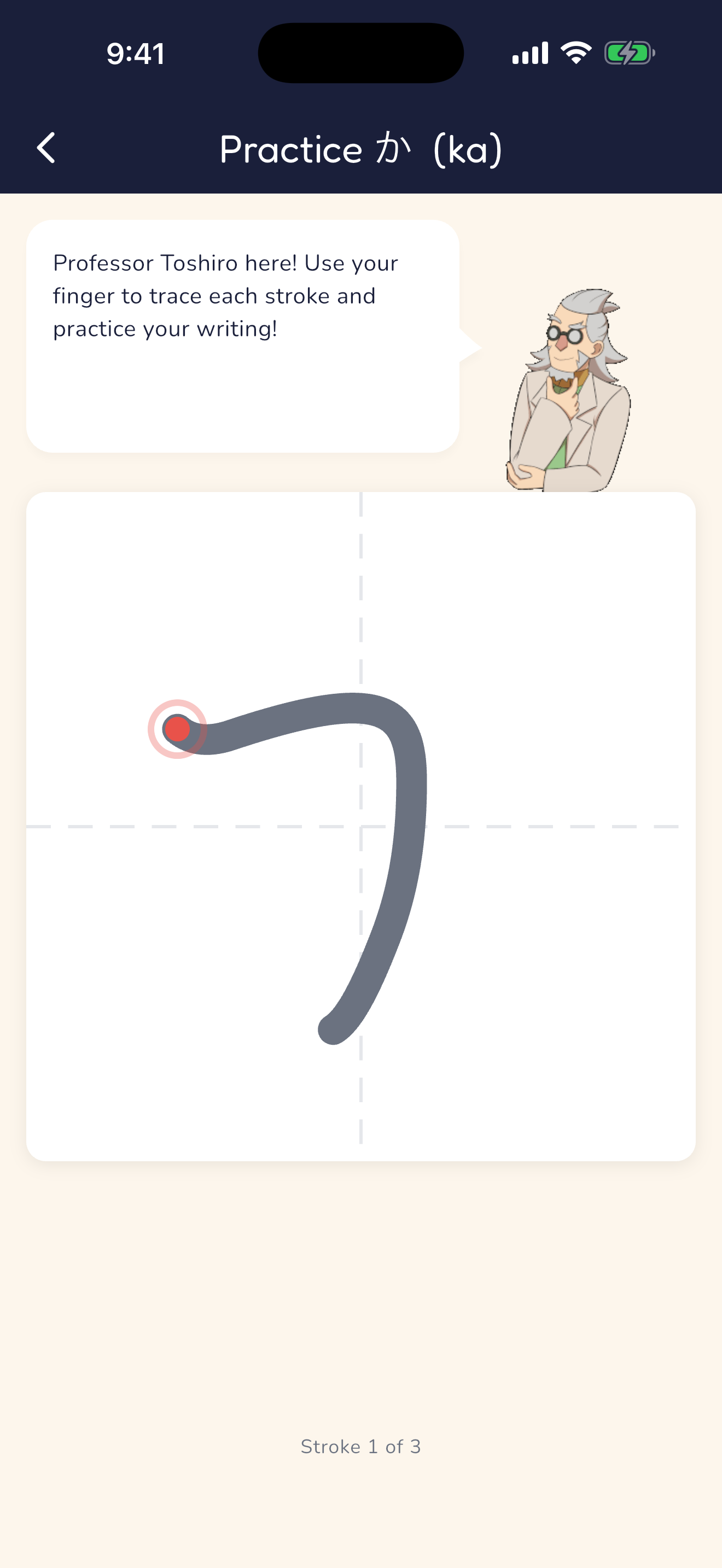
Learn hiragana with Nihongo Master
Nihongo Master turns this chart into an interactive course — with audio, stroke-order practice, spaced-repetition drills, and quizzes that adapt to what you find hard. Start free and learn hiragana the fun way.

Next steps
Hiragana FAQ
How many hiragana characters are there?
There are 46 basic hiragana characters. With dakuten and handakuten (voiced and semi-voiced marks) and yōon (combination sounds), the full set of sounds you can write comes to just over 100.
How long does it take to learn hiragana?
Most learners can read all 46 basic hiragana within one to two weeks of daily practice. Using spaced repetition and writing each character by hand speeds this up considerably.
What is the difference between hiragana and katakana?
Hiragana and katakana represent the same set of sounds. Hiragana is used for native Japanese words and grammar, while katakana is used mainly for foreign loanwords, names, and emphasis.
Should I learn hiragana or katakana first?
Learn hiragana first. It appears far more often in everyday Japanese and grammar, and it is the foundation most textbooks and courses build on before introducing katakana and kanji.
Free Japanese learning resources
Everything you need to start — no account required.
- Free Katakana Chart The full katakana syllabary plus a free downloadable chart.
- Free JLPT N5 Practice Test Test your level with instant scoring and answer explanations.
- Free JLPT Levels Guide All five levels explained, with tests and complete study lists.
- Tool Japanese Dictionary Look up any word with readings, meanings, and example sentences.
- Free JLPT Study Lists Complete kanji and vocabulary lists for every level, N5 to N1.
- Free Mobile Apps Free iPhone apps: master the kana and use the dictionary offline.