
The Best Way to Learn Japanese (From Zero to Conversational)
There is no single "best way" to learn Japanese, but there is a best order. Most people quit for one of two reasons: they jump straight to kanji or grammar before they can read the two basic alphabets, or they collect a dozen apps and never follow any of them through. Both are avoidable.
This guide gives you the sequence that actually works: learn the kana, build a daily review habit, add grammar in context, learn kanji by how common it is, and start using real Japanese as early as you can. Follow it in order and you can reach simple conversations in a matter of months, not years. We will also be honest about how long each stage really takes.
First, a word on difficulty
Japanese has a reputation for being difficult. The short version: the writing system genuinely is, and the rest of the language is easier than you would guess — the grammar is consistent, there are almost no irregular verbs, and pronunciation is simple for most English speakers. The hard part is staying consistent long enough for the pieces to connect, which is exactly what the five steps below are for.
For the full picture, see is Japanese hard to learn?
The 5-step roadmap (at a glance)
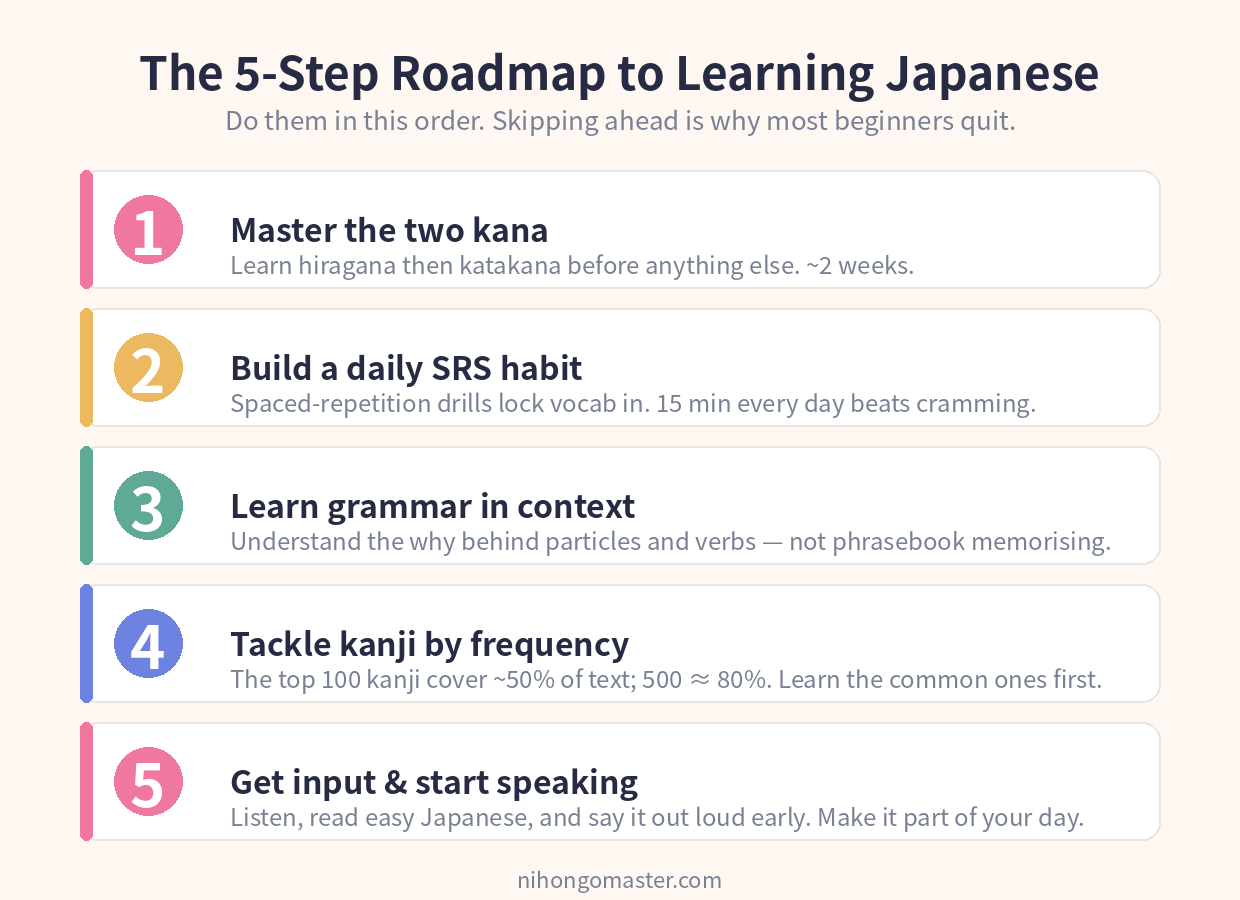
- Master the two kana (hiragana, then katakana).
- Build a daily spaced-repetition habit.
- Learn grammar in context, not as isolated rules.
- Tackle kanji by frequency, common characters first.
- Get input and start speaking as early as you can.
The order matters. Each step makes the next one easier, and skipping ahead is the single most common reason beginners stall. Here is how to do each one well.
Step 1: Learn hiragana and katakana first
Before anything else, learn the two phonetic alphabets. Hiragana is used for native Japanese words and grammar, and katakana is used for foreign and loan words. Together they are called the kana, and there are about 46 basic characters in each.
Learn them first for one simple reason: every good resource beyond the absolute basics is written in kana, not romanized letters. If you lean on romaji (Japanese written with the English alphabet), you build a crutch you will later have to throw away, and your pronunciation suffers. Most learners can read both kana comfortably in one to two weeks of daily practice.
Start with our free hiragana chart and katakana chart, practice writing each character by hand, and quiz yourself daily until recognition is instant.
Step 2: Build a daily spaced-repetition habit
The learners who succeed are not the ones who study for six hours on a Sunday and then nothing for a week. They are the ones who do a short review every single day. The tool that makes this efficient is spaced repetition (SRS): a system that shows you each word or character right before you are about to forget it, so nothing slips away and you never waste time on things you already know.
Fifteen focused minutes of SRS a day will beat an hour of passive re-reading. Build the habit early, attach it to something you already do daily (morning coffee, commute), and protect it. Our spaced-repetition drills schedule this for you automatically, but the principle matters more than any single app: review a little, every day, forever.
Step 3: Learn grammar in context, not as rules to memorize
Once you can read kana, start grammar. The mistake here is treating Japanese grammar like a list of phrases to memorize. Japanese works very differently from English: the verb goes at the end, small words called particles (は, が, を, に) mark the job each word does in a sentence, and there is no need for plurals or articles like "a" and "the."
Because of this, you want to understand the why, not just the what. Learn how particles work and the sentence will unlock thousands of combinations. Learn ten set phrases and you have learned ten phrases. Work through grammar in a structured order, see each point used in real example sentences, and review it with your daily drills. Our grammar lessons explain the reasoning and cultural context behind each rule rather than asking you to memorize blindly.
Step 4: Tackle kanji by frequency
Kanji, the characters borrowed from Chinese, are what scare most beginners off. There are over 2,000 in everyday use, and trying to learn them in random order is overwhelming. The trick is to learn them by frequency, common ones first, because a small set does most of the work.
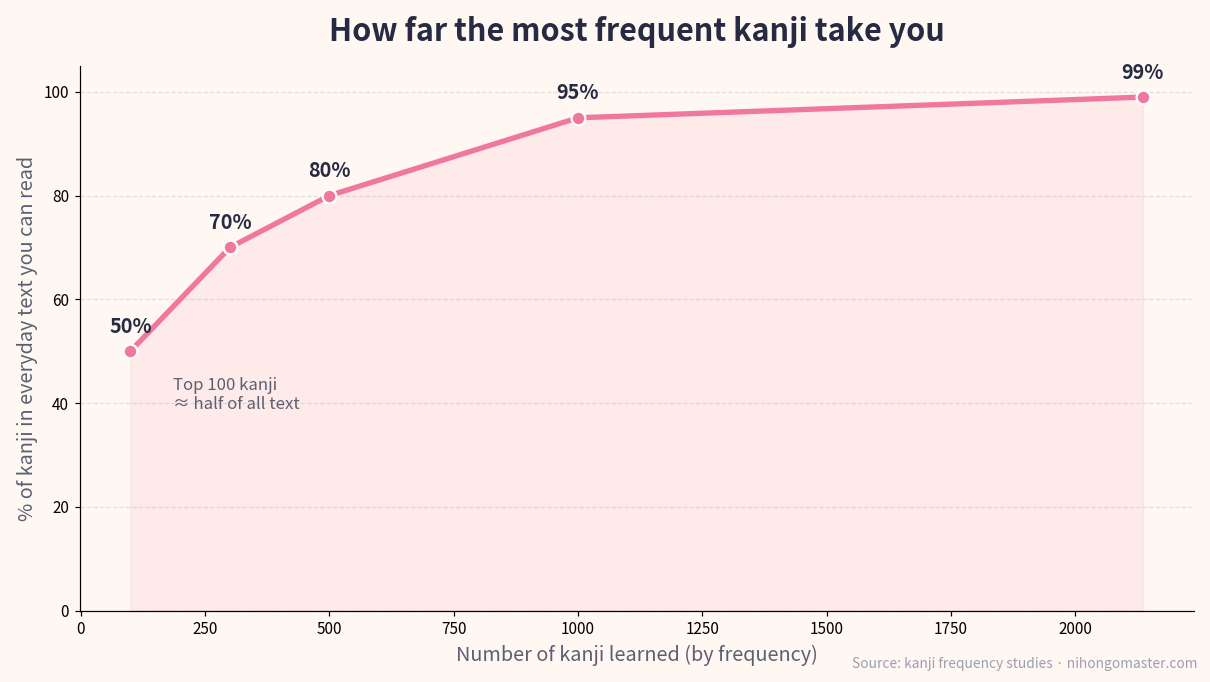
The numbers are encouraging. The top 100 kanji cover roughly half of the characters in everyday text. The top 500 get you to about 80%, and the top 1,000 to about 95%. You do not need all 2,136 standard characters to read most of what you encounter. Use radicals (the building blocks kanji are made from) and mnemonics to make them stick, learn each one alongside the vocabulary that uses it, and review with SRS. Our kanji dictionary shows stroke order, readings, and example words for each character.
Step 5: Get input and start speaking
You do not have to wait until you are "ready" to use Japanese. Start early, in two directions at once.
Input means listening and reading at a level you can mostly follow. This is how vocabulary and grammar move from "studied" to "automatic." Free resources like NHK News Web Easy offer simple news written for learners, and graded readers and beginner podcasts work the same way. Once you reach an intermediate level, manga and shows become great practice.
Output means producing Japanese yourself, speaking and writing. Say new words out loud, try shadowing (repeating audio right after you hear it), and write short sentences. When you are ready for real conversation, practice with other learners and native speakers in a community. Speaking early feels uncomfortable, but it is where passive knowledge becomes a real skill.
A realistic sense of the timeline
Be realistic, and you will be far more likely to stick with it. At a steady one hour a day, basic conversational ability (around JLPT N5) is roughly a year away — and you will be having simple exchanges well before that. The exact number matters less than the habit.
For the full picture — study-hour estimates for every JLPT level and what they look like at your daily pace — see our guide to how long it takes to learn Japanese. And to keep yourself honest, try our free JLPT N5 practice test to see where you stand.
Free vs paid tools, and how to avoid app-hopping
You can learn Japanese entirely free if you are disciplined: free kana charts, free SRS software like Anki, free reading from NHK Easy. The catch is that you have to assemble and sequence it all yourself, and decide what to do next at every step. That decision fatigue is what leads to app-hopping, the habit of jumping between five tools and never finishing any of them.
A paid, structured course removes that friction by giving you one ordered path and tracking your progress, so you always know the next thing to do. Whichever route you choose, the rule is the same: pick one core path and follow it. Variety is the enemy of consistency in the early months.
If you are deciding which tool to start with, see our breakdown of the best apps to learn Japanese.
Common beginner mistakes to avoid
- Leaning on romaji. Learn the kana first; romaji holds your reading and pronunciation back.
- App-hopping. Pick one main path and finish it before adding extras.
- Studying passively. Re-reading notes feels productive but does little. Use active recall and SRS.
- Skipping speaking. Waiting until you feel "ready" means you never start. Speak early.
- Chasing kanji in random order. Learn by frequency, with the vocabulary that uses each character.
A done-for-you path: how Nihongo Master fits in
If you would rather not assemble all of this yourself, this is exactly what Nihongo Master is built to do. It sequences all five steps into one path: structured lessons from JLPT N5 through N1, spaced-repetition drills that handle your daily review, an AI teacher that explains your mistakes in plain English, a built-in dictionary, and printable handwriting practice. You always know the next thing to do, which is what keeps people going.
There is a free tier and a 14-day trial, so you can start today without a credit card.
Your first 30 days: a quick-start checklist
- Week 1: Learn hiragana. Practice writing each character daily.
- Week 2: Learn katakana. Start a daily SRS review habit.
- Week 3: Begin grammar (particles は/が/を, basic sentence order) and your first ~50 common words.
- Week 4: Add your first 20–30 high-frequency kanji; read one NHK Easy article; say five sentences out loud.
- Take the JLPT N5 practice test to set your baseline.
Frequently asked questions
What is the fastest way to learn Japanese?
The fastest sustainable way is daily consistency over intensity: learn the kana first, do a short spaced-repetition review every day, learn grammar in context, and start listening and speaking early. Short daily sessions beat occasional long ones.
Should I learn hiragana or kanji first?
Hiragana first, then katakana, then kanji. The kana are the foundation everything else is written in. Starting kanji before you can read kana makes the whole process harder.
What should I do every day to learn Japanese?
A sustainable daily session has three parts: your spaced-repetition review first (it is the part that cannot be skipped), then one new lesson or grammar point, then a few minutes of listening or reading input. Thirty to sixty focused minutes covers all three.
Can I learn Japanese on my own?
Yes. Many people self-study successfully with a clear plan and daily habit. The main risk is losing direction and app-hopping, which a structured course or a fixed routine prevents.
Do I need to learn kanji to speak Japanese?
To speak, kanji is less urgent, but to read almost anything you do need it. Learn kanji by frequency alongside vocabulary; the top 100 characters alone cover about half of everyday text.
Free Japanese learning resources
Everything you need to start — no account required.
- Free Hiragana Chart All 46 characters with readings, stroke order & a printable PDF.
- Free Katakana Chart The full katakana syllabary plus a free downloadable chart.
- Free JLPT N5 Practice Test Test your level with instant scoring and answer explanations.
- Free JLPT Levels Guide All five levels explained, with tests and complete study lists.
- Tool Japanese Dictionary Look up any word with readings, meanings, and example sentences.
- Free JLPT Study Lists Complete kanji and vocabulary lists for every level, N5 to N1.
- Free Mobile Apps Free iPhone apps: master the kana and use the dictionary offline.