
How Long Does It Take to Learn Japanese?
The short answer: about 350–450 hours to basic conversational ability (JLPT N5) — roughly a year at an hour a day — and several thousand hours to full fluency. You will be exchanging simple sentences within a few months. The long tail is almost entirely the writing system, not the spoken language.
Those numbers are more useful than "it depends", but only if you read them the right way: Japanese is not a language you finish, it is a language you accumulate — so the honest question is not "how long until I'm done" but "how long until it's useful". The answer to that one is measured in months, not years.
The JLPT timeline: hours by level
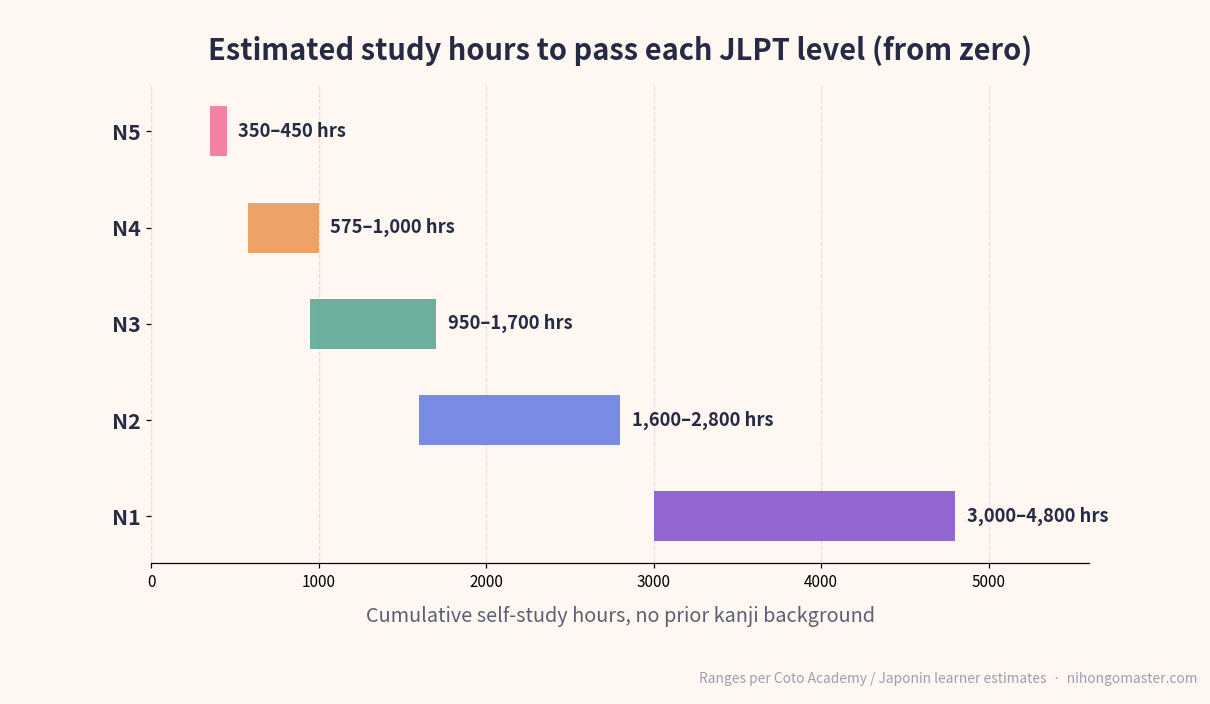
The Japanese-Language Proficiency Test (JLPT) splits proficiency into five levels, from N5 (basic) to N1 (advanced), which makes it the most concrete yardstick available. The widely cited study-hour estimates look like this for a learner starting from zero with no prior kanji background:
| Level | What it means | Hours from zero (no kanji background) |
|---|---|---|
| N5 | Basic greetings, simple sentences | ~350–450 |
| N4 | Everyday conversations, basic reading | ~575–1,000 |
| N3 | Intermediate, the "bridge" level | ~950–1,700 |
| N2 | Comfortable with news and work topics | ~1,600–2,800 |
| N1 | Advanced, near-native reading | ~3,000–4,800 |
(Hour ranges per learner estimates from Coto Academy and Japonin.) Treat the ranges as honest error bars, not precision: your starting point, methods, and — more than anything — consistency move you within them. A good way to keep yourself honest is to aim at the first milestone: our free JLPT N5 practice test shows you exactly where you stand.
What that means at your pace
Hour totals only become a plan once you divide them by a daily habit. Here is the same data as calendar time, at the three most common real-world paces:
| Daily study | N5 (conversational basics) | N3 (solid intermediate) | N1 (near-native reading) |
|---|---|---|---|
| 30 min | ~2–2.5 years | ~5–9 years | A decade-plus project |
| 1 hour | ~12–15 months | ~2.5–4.5 years | ~8+ years |
| 2 hours | ~6–7 months | ~1.5–2.5 years | ~4–6.5 years |
Two things jump out of that table. First, doubling your daily time roughly halves the calendar — there is no cliff where extra effort stops paying. Second, the 30-minute row still gets everywhere the others do. Slower is fine. Stopped is the only pace that fails.
What you can actually do at 3, 6, and 12 months
Hour counts undersell how front-loaded the useful stuff is. At a steady hour a day:
- 3 months (~90 hours). Both kana are solid — you can read hiragana and katakana without thinking — plus a few hundred words and the set phrases that carry most everyday situations: ordering, asking directions, introducing yourself.
- 6 months (~180 hours). Simple back-and-forth exchanges, half of N5 grammar, your first hundred N5 kanji. Menus and signs start dissolving into words instead of symbols. This is where Japan travel stops being intimidating.
- 12 months (~365 hours). N5 territory: basic conversations on familiar topics, reading simple texts with furigana, following slow, clear speech. You have also built the thing that actually determines the rest of the journey — the daily habit.
What makes it faster (and what quietly makes it slower)
- Faster: daily spaced repetition. Most of learning Japanese is retaining thousands of small items, which is exactly the problem spaced repetition solves. Fifteen minutes of review every day compounds; three hours on Sunday does not.
- Faster: kanji by frequency, inside vocabulary. The most common 100 characters cover roughly half of everyday text. Learning them inside real words, in frequency order, means you read real Japanese months earlier than grade-order study allows.
- Faster: early listening input. Comprehension lags reading for almost everyone, and only hours of input close the gap — the earlier you start, the shorter the lag.
- Slower: the romaji crutch. Reading Japanese in English letters feels efficient for two weeks and then taxes every hour that follows. Learn the kana first.
- Slower: app-hopping. Restarting in a new tool replays the same beginner material and resets your momentum. Pick one path and finish it — the method matters less than the not-switching. Our guide to the best way to learn Japanese lays out the full sequence.
About that 2,200-hour number
You will also see a much bigger figure quoted: the US Foreign Service Institute's estimate of roughly 2,200 class hours to professional working proficiency. Both numbers are right — they measure different things. FSI means negotiating contracts and reading newspapers; the N5 estimate means holding real, simple conversations. One is a career milestone, the other is a first-year goal. Japanese lands in FSI's hardest category almost entirely because of the writing system — the spoken language is far friendlier than the label suggests. For the full picture of what is genuinely difficult and what is not, see Is Japanese hard to learn?
The verdict
A year of an hour a day buys you conversational basics. A few years of the same habit buys you the language. Every credible estimate — JLPT hours, FSI categories, learner surveys — agrees on the shape: useful arrives early, mastery arrives late, and daily consistency is the only variable you fully control.
So the practical move is not to shorten the road. It is to make the daily hour automatic.
Make the daily hour automatic
If the timeline is decided by consistency, then consistency is the thing worth buying. That is what Nihongo Master is built for: one ordered path from N5 through N1, spaced-repetition drills that decide what you review each day, an AI teacher that explains mistakes in plain English, and a built-in dictionary. You never have to work out what to do next — which is the decision that quietly ends most people's Japanese.
The dictionary and kana charts are free, and the full course comes with a 14-day free trial you can cancel anytime before it ends.
Frequently asked questions
How long does it take to learn Japanese?
Basic conversational ability (around JLPT N5) takes most self-learners 350 to 450 hours — roughly a year at an hour a day. Comfortable everyday fluency (around N2) is closer to 1,600 to 2,800 hours, and near-native reading (N1) runs 3,000 hours or more. You will be having simple exchanges within a few months; the long tail is mostly the writing system.
Can I learn Japanese in a year?
In a year at an hour a day you can realistically reach JLPT N5: simple conversations, basic reading in kana plus early kanji, and enough Japanese to navigate travel comfortably. A year of two or more focused hours a day can reach N4 or brush N3. What a year will not produce, at any intensity, is effortless fluency — that is a multi-year accumulation.
Can I learn Japanese in 3 months?
You can learn a genuinely useful amount in 3 months: both kana, a few hundred words, and set phrases for real situations. That is a strong start, not proficiency. Claims of fluency in 90 days redefine the word fluency.
How long does it take to learn Japanese fluently?
For comfortable, wide-ranging fluency — following native media, reading books, working in Japanese — plan in years, not months: typically 2 to 5 years depending on daily hours. The US Foreign Service Institute estimates roughly 2,200 class hours to professional working proficiency, and its students study full-time.
How many hours a day should I study Japanese?
The best schedule is the one that survives contact with your life. Thirty to sixty minutes daily outperforms occasional marathon sessions, because memory responds to frequency. If you have more time, split it: spaced-repetition review, new material, and listening input.
Does kanji make Japanese take longer?
Yes — the writing system is most of the gap between Japanese and a European language. Spoken Japanese on its own is far quicker to acquire. Learning kanji by frequency inside real vocabulary, with daily spaced repetition, is the fastest known route through it.
Free Japanese learning resources
Everything you need to start — no account required.
- Free Hiragana Chart All 46 characters with readings, stroke order & a printable PDF.
- Free Katakana Chart The full katakana syllabary plus a free downloadable chart.
- Free JLPT N5 Practice Test Test your level with instant scoring and answer explanations.
- Free JLPT Levels Guide All five levels explained, with tests and complete study lists.
- Tool Japanese Dictionary Look up any word with readings, meanings, and example sentences.
- Free JLPT Study Lists Complete kanji and vocabulary lists for every level, N5 to N1.
- Free Mobile Apps Free iPhone apps: master the kana and use the dictionary offline.